
The Beginning — Timeline
2016 — The Start of Korea-China Cooperation
Sejong-e Co., Ltd. signed a business agreement with the China Internet Online Service Association (a first-tier association under China's Ministry of Culture managing 148,000 internet cafes, with revenue of roughly 45 trillion KRW as of 2015). It went on to become the first to export an esports curriculum to China, to Beijing Huajia Vocational College's Esports College, a university designated by China's Ministry of Culture.
Began preparing to open a joint Korea-China esports department, with Korean-language classes taught by instructors dispatched from Korea.
2018 — Certification Standardization and Official Launch
Became the first to join China's esports certification standardization, receiving an authorization valid through November 2028. In the same period, produced China's first graduating class of an esports college, and jointly standardized about 20 Korea-China esports certifications.
At China's request, the International Esports Promotion Institute (IESI) was officially launched, positioned as a lifelong and national sport.
2019 — Expanding Korea-China Exchange
Supported training in Korea for regional association heads operating esports halls across 23 provinces in China.
Supported training in Korea for Tencent VSPN staff.
Held the Korea-China International Esports Academy Forum.
Created the CKEC Korea-China Esports Tournament title, launching an annual Korea-China 128-team league, an international forum, and an industry expo.
2020–2021 — Expanding Tournaments and Talent Development
Held the Korea-China Esports Tournament and the Metaverse Esports Tournament in 2020 and 2021.
Founded the Esports Froom Academy to develop esports industry talent, dispatching esports instructors and supporting tournaments at specialized high schools, schools for students with disabilities, elementary/middle/high schools, economic innovation centers, and many other institutions.
Held the CKEC Esports LoL Tournament.
2022–2023 — Expanding Industry Infrastructure
Established the Korea-China Esports Memorial Hall, also serving as the Wanghong Media Center, at a Chinese science and industry park. CKEC's China subsidiary promotes and operates the Wanghong Media Center via TikTok.
Developed an esports industrial complex among other projects, and conducted training for the "Rock & Roll" esports team at the Hanam City Youth Training Center.
Signed a game publishing license (banhao) agreement for China.
Signed agreements with Tencent covering esports tournaments, PC-cafe game promotion and operations related to Tencent's new platform (to launch in 2024), and concluded business agreements with 70 additional institutions and companies beyond that contract.
The domestic and global esports industry has grown substantially over the past five years, shifting public perception of esports games and strengthening its influence across every industry sector. The industry has grown at over 20% per year, and this trend continues to spread worldwide. In September 2023, the Asian Games produced 7 gold medals in esports along with military service exemptions for medalists. Overseas, real estate development has produced roughly 40,000 esports hotels in China, some of which were used on-site during the Asian Games. In the United States, about 500 dedicated esports colleges have been established, training talent from around the world.
Esports (Electronic Sports) refers to games played online via computer networks or the internet. With approximately 2.5 billion esports gamers worldwide and about 550 million viewers as of 2021, mainstream adoption is an unavoidable reality. IESI is turning this into a new economic growth opportunity through systematic domestic and international research, business model discovery, hosting various tournaments and forums at home and abroad, and building out the industrialization framework for esports.
A worldwide trend
+ Military exemptions introduced
Built through real estate development
Training global talent
As of 2021
Korean Esports: A 100-Year Industry
The esports industry is a leading convergence industry within the digital fourth industrial revolution, and there is a strong need to energize it as a future growth engine for the national economy and digital esports culture. Korea, as the birthplace of esports, holds an esports culture industry it can proudly showcase to the world — one that sits at the core of the K-wave.
With 7 gold medals and military exemptions at the Asian Games, the esports industry now sits at the center of a digital era marked by explosive demand for esports-driven economic activity, esports real estate development (such as esports hotels), and esports education. The growth of the esports industry is also becoming a foundation for "creating new jobs," boosting employment, and spreading esports gaming culture as part of the Korean Wave.
IESI supports the cultivation of this esports industry ecosystem. To that end, it contributes to industry development through R&D on esports products, tournament promotion, and support for exporting esports systems, and it supports diverse community activities — health management, leisure and culture, and social participation — serving as a platform that provides integrated esports services.
IESI views the digital esports industry as Korea's "100-year industry" — one that will not disappear even after a century, only continuing to change and spread worldwide. Building its international foundation quickly around esports talent development and esports as both a lifelong and national sport, IESI has founded and continues to support the Esports Froom Academy, operates amateur and professional esports teams, and dispatches talent to many institutions and schools.
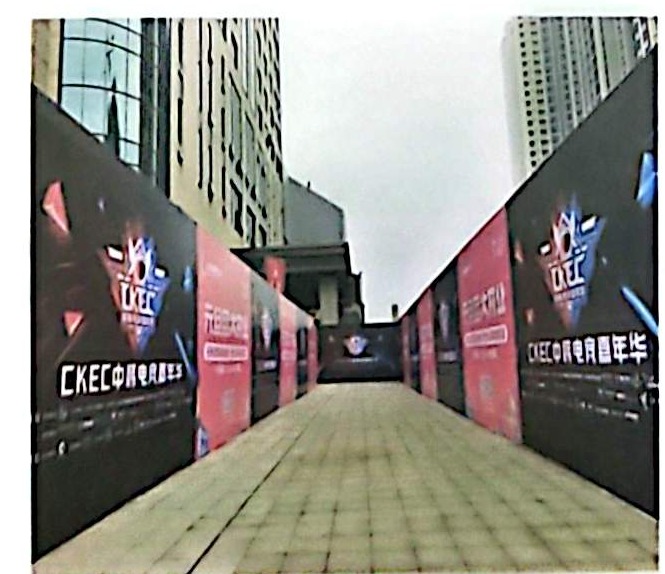
Street banners at the CKEC Korea-China Esports Tournament
International Esports Promotion Institute (IESI) logo and seal